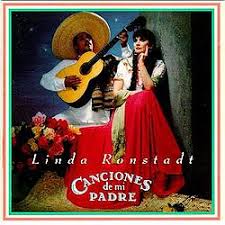
 Linda Ronstadt’s tour through the Great American Songbook was inspired by the records her mother played for her as a child. In the late 80s, she decided it was time to honor the music of her father.
Ronstadt’s Mexican roots trace back through her father, Gilbert, whose grandfather emigrated from Germany to Mexico and met his wife there. Mexican music was a major part of both Gilbert’s and Linda’s childhoods.
Ronstadt had written a Spanish-language song for an early album, and recorded a Spanish version of ‘Blue Bayou’ as a standalone single, but now she embarked on an ambitious project to celebrate the Mariachi tradition on a studio album.
Canciones de Mi Padre was released in late 1987 and found Ronstadt giving full-throated voice to traditional Mexican songs. Backing her were the three Mariachi bands considered the best in the world, assembled on one recording for the first time.
It was a smash hit, selling more than 10 million copies worldwide and more than 2 million in the U.S. (it remains the best-selling Spanish-language album in American history). It also earned Ronstadt her fourth Grammy, this one for Best Mexican-American Performance (the Grammys have a category for everything).
In 1991, Ronstadt released a second set of Mariachi songs on the appropriately titled Mas Canciones. A year later, she released Frenesí, a collection of Spanish-language standards in the bolero and mambo traditions. Each of those albums took home Grammys as well.
My Spanish isn’t strong enough to know exactly what she’s saying on any of these albums, but the songs showcase her powerful, versatile vocals even better than her English-language material. I loved listening to every one.
🎵 Part of the Linda Ronstadt Deep Dive 🎵
This post is part of my exploration of Linda Ronstadt’s studio catalog.
→ Return to the Linda Ronstadt Deep Dive
Que acabe tu sonsonete
Que tu canto aqui en el alma
Como un punal se me mete
Sabiendo que cuando cantas
Pregonado vas tu muerte
Marinero marinero
Dime si es verdad que sabas
Porque distinguir no puedo
Si en el fondo de los mares
Hay otro color mas negro
Que el color de mis pesares
Un palomito al volar
Que llevaba el pecho herido
Ya casi para llorar
Me dijo muy afligido
Ya me canso de buscar
Un amor correspondido
Bajo la sombra de un arbol
Y al compas de mi guitarra
Canto alegre este huapango
Porque la vida se acaba
Y quiero morir cantando
Como muere la cigarra


This foray into Spanish language albums was really the last time Ronstadt was on my radar. I’ll be curious to know what she was up to between these releases and her medical issues.
I never really got into the Spanish music but still appreciate her beautiful voice