 Last year Shakira suffered her first commercial failure in some time, when her dance-heavy English-language She Wolf album failed to light up the charts.
Now, it seems a bit silly in this era to call 350,000 U.S. copies sold (not to mention 1.5 million worldwide) a disappointment but for an artist who’s sold more than 50 million copies of her previous five albums, I suppose the bar is set a little higher.
Despite its tepid sales, She Wolf was an artistic and critical success, its dance-pop sheen highlighting some of the most indelible melodies and infectious beats of Shakira’s career. But according to whoever writes the rules for pop music, the album has gone down as a failure.
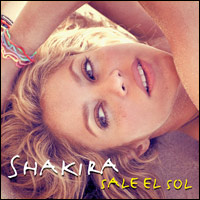
Just a year later, Shakira is back with Sale el Sol, a stylistic return to the sound of her early hits and her first Spanish-language release since 2005’s La Fijación Oral Vol. 1. A cynic might call it a craven ploy to recapture the audience who didn’t follow her on her last detour. Others would say it’s just the latest step in the musical evolution of an artist who rarely stays in one place for long.
Doesn’t matter. Sale el Sol is a roaring success, Shakira’s most consistently excellent record since 1998’s ¿Dónde Están los Ladrones?.
Shakira does triple duty here, not just writing and performing the songs but producing as well. And she is in top form in all three areas.
As I began my countdown of favorite female singers this week, I was reminded of a comment I once read about Shakira’s voice: “She sounds like Alanis Morissette with swine flu.” Harsh, certainly, but I kind of know what that person meant. There’s a strident quality in some of her vocals that can be off-putting.
But, as I’ve pointed out before on the blog (prompting much debate), Shakira in Spanish is a whole different ballgame. Whether it’s her familiarity with her mother tongue, some quality in the sounds of the words themselves, or maybe just those fabulous rolled r’s, she sounds just wonderful.
The songs on Sale el Sol can be split into three basic categories: pop-rock, lush balladry and Latin dance/rap. Shakira has dives into all of these genres in the past but never so successfully all at once. This album is a sort of greatest hits record of her musical styles (or, as she put it in an interview, “it’s like a synthesis of all these 20 years”).
While every cut on the album is a winner, the standouts are the dance tracks. The album was recorded partly in the Dominican Republic and the Bahamas and on tracks such as ‘Loca’ and ‘Rabiosa’ the feel of those islands pours out of the speakers. Fusing horns and street drums, merengue and Latin rap, if these songs don’t get you moving, you must be paralyzed from the neck down.
But it’s not just her hips that don’t lie on Sale el Sol. Rocker ‘Devoción’ boasts a rhythm section, lead guitar and anthemic chorus that should make Kings of Leon jealous. ‘Mariposas’ is a pop gem that would be a monster hit if the Glee kids took a stab at it. ‘Lo Que Mas,’ with its grand piano and lush strings, calls to mind a Colombian Fiona Apple.
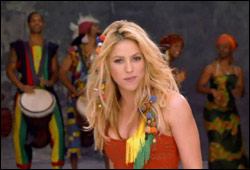
And then there’s ‘Waka Waka (Esto Es Africa),’ the World Cup theme Shakira released this summer that has received 200 million (and counting) views on YouTube. It shows up on Sale el Sol in a Spanish-language version that really drives home its multicultural up-with-people message.
Shakira has quietly and steadily emerged as one of the most versatile talents in the industry. Her mastery of such disparate genres — not to mention different languages — is beyond impressive. Rather than come up with a suitable kicker for this review, I’m just going to steal this one from AllMusic.com: “Listen closely and it becomes apparent that nobody makes better pop records in the new millennium than she does.”
 Meet Me In Montauk
Blah, blah, musical artistry, blah, blah.
Smoking. Hot.