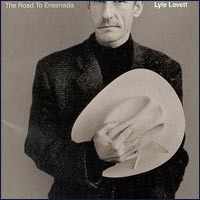
 Last September, during a Lyle Lovett theme week, I singled out one song from his album The Road the Ensenada and promised to highlight two other songs — the album’s best — on future dates. I fulfilled half of the promise in November, when I featured ‘Her First Mistake‘ as a Song of the Day. Today I complete the mission.
For my money, the title track of The Road the Ensenada is possibly the finest song Lovett has ever written, and among the finest I’ve ever heard. That’s high praise for a relatively simple song but Lovett is no stranger to high praise, at least from this corner.
I believe the song’s success owes as much to its production and performance as it does to its construction. Lovett isn’t doing anything out of the ordinary here, either lyrically or musically. He has written far more adventurous and clever songs. But he sings this one like it’s the last breath of a dying man and the haunting instrumentation supports that elegiac tone.
I suspect the song itself is about death. The narrator lies sick and broken waiting for the arrival of a loved one who doesn’t come. The second half of the song (following “no sign of you”) seems to be a reminiscence of his own travels, when he left tamer country to head south. The line that puzzles me is the chorus’ repeated “You ain’t no friend to me.” Who isn’t? Or what?
I’m sorely disappointed in the Web’s offerings about this song. None of the album reviews I found single it out, none of the “song meaning” sites feature it. How can a song this good, and this meaty, go ignored? Maybe this blog entry will serve as a net that brings in fellow fans to appreciate and interpret the Lyle Lovett masterpiece.
Viva Mexico
My eyes just won’t stay open
And I dream a dream of home
I dream a dream of home
Where there’s coffee on the table
And kindness in your hand
Honey I’ll help you when I’m able
But right now I’m feeling bad
Right now I’m feeling bad
Listen to your heart that beats
And follow it with both your feet
And as you walk and as you breathe
You ain’t no friend to me
You ain’t no friend to me
The road to Ensenada
Is plenty wide and fast
If you head South from Tijuana
Then I’ll see you at last
I’ll see you at last
But my eyes they open slowly
And they look around the room
The old man he seems worried
And there ain’t no sign of you
There ain’t no sign of you
Listen to your heart that beats
And follow it with both your feet
And as you walk and as you breathe
You ain’t no friend to me
You ain’t no friend to me
You can offer to the righteous
The good that you have won
But down here among the unclean
Your good work just comes undone
Your good work just comes undone
The sisters at the borderline
They’re holding out their hands
They’re begging me for something Lord
But I don’t understand
I don’t understand
So it’s adios to Alvero
Tell him to stay between the lines
And if he sees that Gabriella girl
Tell her I’ll look her up next time
Say I’ll look her up next time
Because the road to Ensenada
Is plenty wide and fast
And this time through Tijuana
Well it won’t be my last
It won’t be my last
Listen to your heart that beats
And follow it with both your feet
And as you walk and as you breathe
You ain’t no friend to me
You ain’t no friend to me
You ain’t no friend to me
 Meet Me In Montauk
I did a little searching and read that this album was right after his marriage to Julia Roberts ended and some of the songs reflect his pain over the breakup. Maybe “you ain’t no friend to me” has something to do with it??
Well, what a treat this is to discover at the end of a long day. I can’t even offer a ballpark figure of how many times I’ve listened to this song, as it is one of those I would often play on a loop. Despite the fact that I’ve overplayed it so, my eyes never cease to sting with the onset of tears by the time Lovett sings that final “you ain’t no friend to me.”
Many years ago, I offered the song up to my AP English class to seek out the insightful interpretations of the wise students gathered there. We had no definitive answers, but the song certainly sparked a great discussion. One interpretation I recall especially liking was that he is addressing himself throughout the song and with the refrain. Rerferring to himself in the second person, the speaker bemoans that “[his] good work comes undone” and that he has been no friend to himself as he has embarked on this journey to Ensenada, literal or figurative as it might be.
The verse that always gets me:
“So it’s adios to Alvero
Tell him to stay between the lines
And if he sees that Gabriella girl
Tell her I’ll look her up next time
Say I’ll look her up next time”
Who is that Gabriella girl, and how will he be able to look her up next time? Will there be a next time? Is she already dead? The advice to “stay between the lines” I find always unbearable poignant. I want to read the novel that explores the relationship between our speaker and Alvero.
Ultimately, I find this song so powerful because it suggests a rich and detailed world that is just hinted at in the enigmatic verses here. That it concludes the album (save for the bonus track) makes it all the more haunting.
I absolutely adore Lyle Lovett; have I ever mentioned that before? Oh, and I’ve listened to the song four times while writing this comment. And I just want to listen to it a dozen times more. What is that all about?
Just stumbled upon this thread and am so pleased to see others have responded as strongly as I to this song. I can’t think of a sadder tune, or a more lyrical, rich and enigmatic one. It’s like a great, minimal short story– in fact I wonder if perhaps it’s based on something literary with its intriguing references to names of other places and characters. The only song I would place right up there with this song in terms of its painful beauty is “Waiting for the Rain” by Wendy Waldman.
This is a lovely live version:
Well, my trial has kept from commenting, but better late than never, especially when it’s on a great Lyle song like this one. I can’t say it’s my favorite Lyle song, but it certainly is up there in the top 10, maybe even top 5.
I’m confounded by the song’s meaning, but I like Amy’s student interpretation. I think it’s a self-exploration—about family, love, loss, and, of course, the metaphor of moving through life as one moves down the roads of Texas to Mexico. The lyrics are great, the music is great. Lyle is great. What else can I say?
Tijuana is love.
“listen to your heart that beats, and follow it with both your feet, and as you walk and as you breathe you aint no friend to me” — hard to grasp.
But maybe..
Life as a musician has many … benefits? and temptations, Gabriella, the girls at the border with their hands out, for something.
I read this that he gave up that ‘free’ life, hoped for coffee at the table, and lost.
Love is illusive to someone who thought they found it but lost it, on the road to Ensenada.
You’re onto something here – but I think it’s the exact opposite. He gave up a life of coffee on the table and kindness in a lover’s hand for a fast and free life…and it broke him.
I think the story goes: He leaves his life to journey the musician’s road (or just the free man’s road), and when it doesn’t work out and he’s sick and broken, he expects the life he left (maybe manifests itself in a person) to come find him. At the very end I like to think he realizes that it ain’t gonna happen and he has to go back and get it himself…or maybe he’s just moving on to the next thing. I think that’s partially the beauty of this song. We don’t really get to know.
“You ain’t no friend to me,” I think, is in reference to himself.
I’m awfully glad that I am not alone in admiring the exquisite power and beauty of this song while remaining perplexed about it’s elusive meaning.
I have often thought, as others in posts above, that it’s a dialog with oneself, one taking place in a sickened state of delirium, but with one added character sitting (and striding) next to him: Jesus. “You can offer to the righteous all the good that you have won, but down here among the unclean, all your good just comes undone.” And in the speaker’s sickened state, he is angry and taunting God and death: “You ain’t no friend to me.”
I try to imagine the room in Mexico where he “lay sick and broken” and can visualize a crucifix and a table-top sculpture of Jesus. “My eyes they open slowly, and they look around the room. The old man he seems worried…”
By no means do I offer this as “my interpretation” but simply a few interpretive impressions that keep returning. As with other posters, I am gripped by this superb work of art and continually seek to understand just what it is that grips me. I don’t mind the journey. I even wonder if Lovett really knows.
I found a video of Lyle performing this while promoting Clark Guitars. I preficed the song by mentioning that Cole Clark is also a personal friend of his. He goes on to say that they go or have gone Bike riding in Baja. Maybe this song is the reflection of a crash ‘n’ burn? Either way, I’ve had this album for at least 6 or 7 yrs and recently this song mezmerizes me..over and over again.
I wonder about a drug connection. I don’t know anything about Lyle Lovett’s habits or history, and it may be about a fictional character, but somehow it seems intuitive.
Enigmatic Lyle Lovett – like a poet or painter – interpret it as you see fit – whatever it means to you. Isn’t he just great. One to clear up – Lyall is a friend of Bill Collings of Collings guitars and it is during a trip with Bill to Mexico that the song evolved.
I have always felt from the first time listening to this haunting song that it is about a man dying and that “you ain’t no friend to me” must refer to the fact that for a dying person, the world of the healthy is so far removed from their current perspective that it has a strangeness to it. Maybe the best way to understand what I am getting at is for you to read Leo Tolstoy’s classic novella “The Death of Ivan Ilyich”. I assume that the narrator of the song is getting medical treatment in Ensenada, and that the opening verses portray him in his hospital bed thinking of home, as he is waiting for a visit from the person to whom the song is addressed.
Ain’t no “friend” because they are so much more; not less.
The song is filled with lines wide open for interpretation. The refrain that ends with “You ain’t for no friend to me” speaks to me of someone who is telling a loved one to follow her heart, but the thought of it taking her away from him is too much to bear. In his despair he protects his own heart by overstating his grief…”You ain’t no friend to me.”
Probably a stretch, but it reminded me immediately of Kerouac being left ‘on starving sidewalks and sickbeds’ by his friend Neal Cassady when they went to Mexico to get a quickie divorce for Cassady. It is mentioned in the opening of the book On the Road and discusses elsewere.
The reason I learned about and bought this album was because of Lyle’s passion with motorcycles. Even today, you can see on his Instagram page his love of motorcycles. I met him once at a motorcycle offroad event back in the early 90’s. This song particularly hit me and reminded me of many trips down in Baja. In fact I think I know who Alvaro was. He helped a motorcycle adventure company run by Chris Haines. If I remember right, Lyle used to ride in Baja with Chris. The song seems to tell the story of someone that had possibly crashed and maybe stuck in a Mexico hospital. Not sure if it was Lyle that was “sick and broken” or that maybe Julia wouldn’t come down to see him, but there are some parallels to his life at the time. I just heard the song again, and it brought me back 20 years to my adventures down in Baja.
I thought this song was pretty straight forward, but you all are making me second guess myself.
I thought it was about a man who was sick or hurt in Mexico. He is very disappointed that his girlfriend or wife is not going down there to be with him in his time of need. He tells her to do what her heart tells her but he loves her too much to just be a friend of hers. He thinks that her not coming to Mexico indicates the end of their relationship, thus he will be free to be with other women (Gabriella et al) next time he is there.
Like many of you that have commented, this is also my favorite Lyle Lovett song. I can’t find the link any longer but Lyle has talked about this song coming straight out of a real-life motorcycle crash he had in Baja. He was obviously quite bitter that his soon-to-be-ex-wife did not come to his side.
Check out Dave Stamey, especially the “Tonopah” album. Off in the same direction of country-fusion, or whatever this ought to be called, albeit a more folksy style.
And yeah, this is Lovett’s best album, so many highlights.
I do have some thoughts about that line, and the song as a whole. I think his thoughts are ranging over friends and lovers over years and years, and there’s bitterness in that past, but that has aged and mellowed and he doesn’t feel that any more. There’s a quiet, calm recognition that someone who used to be so important, who was everything, is not in his life now in any way (“there’s no sign of you”) and while we often say we’ll still be friends after a split, in reality, certainly after many years, actually you’re not friends, you don’t socialise together, you don’t phone each other up, your worlds gradually eddy apart. He recognises and accepts that they’re not friends any more, and won’t be again, but there’s no resentment now about that. And paths may cross, or maybe they won’t, and that’s ok.
This is one of the all time best songs ever. Hauntingly beautiful and it gets into your bloodstream and heads straight for your heart. It is severely under rated.
This song means much to me. In 1997/98 I probably drove the road to Ensenada over fifty times. I was living in my sailboat with my wife and driving to San Diego to get parts. There are two roads, the “libre” or free road has no toll and winds through small towns where you can see the the scenes of the album artwork. The toll road is “plenty and fast”. There are “sisters“, or at least women in some type of white nun/nurse headdress asking for donations. At the border going from Mexico to the US there are about fifty lanes squeezing down to ten and there are white lines to stay between but I don’t know if this is what the Alvaro line refers to. Soon after my wife developed cancer and passed away. This sad song takes me straight back to those times.
Lyle Lovett’s song, “The Road to Ensenada”, is the final scene in an unlikely story of forbidden love, mortal sin, and rejection. In first person narrative and told through the dream of a grieving person, Lyle Lovett exploits human bias, metaphors, and grief to challenge the curious. Discovery is in the realm of imagination, a place where power, morality, and vice intersect.
Scene Setter
An American priest, secretly in love with a Tijuana prostitute, faces an unthinkable dilemma when the woman becomes pregnant. The priest can listen to his heart, seek forgiveness from God, and serve the righteous. Or leave the church in disgrace for a woman he loves, and a child conceived in sin. He chooses God.
Feeling abandoned and exploited, the woman views abortion as her only choice. They quarreled for days. The priest, fearful of complicity in the eyes of God, begs her to reconsider and even argues the selflessness of the Virgin Mary. She refuses. Heartbroken and disillusioned, she returns to Ensenada to end her pregnancy and convalesce before returning to Tijuana. She grieves for the priest she loves and the unborn child she will never hold.
Unveiling the mastery of Lyle Lovett’s storytelling.
Unlike a physical maze, cognitive bias has no boundaries. Lyle Lovett exploits this pathway in the first verse with his hushed baritone voice and low-key instrumental. If unchallenged, the song is from a man’s perspective. But what if the song is from a woman’s perspective?
To be “unclean” is to be immoral or spiritually impure. In the third verse, the protagonist views the world in binary terms, the righteous vs. the unclean. In the final chorus, the protagonist laments a return to Tijuana, a city on the borderline, well known for its red-light district. Is the lyrical use of “unclean” a metaphor for prostitution? If the song is from a woman’s perspective, is she a prostitute?
Gabriella is the feminine name of Gabriel and in Hebrew means devoted to God. Gabriel was the archangel who came to the Virgin Mary and told her that she would give birth to a son. In the fourth verse, is the expression, “that Gabriella girl”, a metaphor for the Virgin Mary, the woman devoted to God? If the song is from a woman’s perspective, is she pregnant?
The protagonist drifts into a dream, “… a dream of home / Where there’s coffee on the table / And kindness in your hand.” In the first verse, if from a pregnant woman’s perspective, is “kindness in your hand” a metaphor for a young child? In her dream, is she responding to a child’s plea for attention, “Honey, I’ll help you when I’m able / But right now I’m feeling bad”?
Within a dream, the protagonist awakens confused. An old man in the room seems worried. Why? Alvero didn’t travel to Ensenada. Was she hoping Alvero would change his mind? In the second verse, if the woman is contemplating an abortion, is the old man the abortionist?
The “sisters” at the borderline, “They’re begging me for something Lord / But I don’t understand.” In the fourth verse, what is the symbolism of the Catholic “sisters” holding out their hands? If the song is from a woman’s perspective, are the sisters interceding on behalf of the unborn child? Are they warning her about a future event, good or bad? Is she feeling guilty about ending her pregnancy?
Those who enjoy Lyle Lovett’s music will ask the obvious question. Where do the lyrics reveal the protagonist a prostitute, Alvero a priest, and introduce a pregnancy? True to Lyle Lovett’s artistry, it is up to the listener to find clues and connect the dots. For example, the link between Tijuana and the “unclean” or prostitutes. The religious connection with “that Gabriella girl”, “the righteous”, and “the sisters at the borderline”, the latter affiliated with the Catholic church.
In the third verse, the protagonist tells Alvero, “You can offer to the righteous / All the good that you have won / But down here among the unclean / All your good just comes undone.” What has Alvero won? If a priest, it is the power and authority given by God to act in His name, and to preach the Faith by word and through example. Meanwhile, in Tijuana, Alvero lives a double life. To the unclean, he is a coward, exploiting nameless women who own nothing but their Mexican heritage. “Viva Mexico!”
The song’s refrain exposes raw emotion, conflict, and despair. If the protagonist is a woman, she is competing with God for Alvero’s love, commitment, and devotion. If a prostitute, she’s an unworthy contender. In a resentful surrender, she tells Alvero, “Listen to your heart that beats / And follow it with both your feet / And as you walk and as you breathe / You ain’t no friend to me.”
In the final verse, the protagonist finds acceptance and meaning. If a woman, her only mistake was falling in love and believing a virtuous man, a priest. On the other hand, Alvero was a plaster saint. As a priest, he lived “outside the lines” of morality and violated his sacred oath with God. Then, fearing God’s judgment, Alvero selfishly exploited the Virgin Mary.
In the final verse, a scornful farewell: “So it’s adios to Alvero / Tell him to stay between the lines / And if he sees that Gabriella girl / Tell her I’ll look her up next time / Say I’ll look her up next time.”
What a novelist does in 350 pages and 90,000 words, Lyle Lovett does in 331 words: a love triangle between a priest, God, and a prostitute. At its most basic level, Lyle Lovett explores raw human emotion, temptation, love, rejection, and acceptance of one’s fate. It is Lyle Lovett’s best work.
Epilogue
The song ends as it begins, in a dream. But a beautiful song deserves a formal ending.
Amori Fati. Alvero, deeply in love, realizes his mistake and selfishness, and resigns from the Catholic church. He arrives at her mother’s home in Ensenada and is sitting by her side when she awakens from her dream. She gives birth to a child six months later. With coffee on the table and “kindness” in their hand, they never look back.
Odium Fati. Alvero, deeply in love, realizes his mistake and selfishness, and resigns from the Catholic church. He arrives at her mother’s home in Ensenada, but it is too late. The woman is dead from an abortion that went terribly wrong. As the congregation arrives for her funeral, Lyle Lovett, wearing a solemn black suit and his finest dress boots, sings “The Road to Ensenada” in a hushed baritone voice and low-key instrumental. Kneeling in the front pew, no longer a priest, Alvero sobs uncontrollably. His sinful lust, greed, envy, weakness as a man, and pride cost him dearly, including the woman he loved, their unborn child, and God’s spiritual authority. A tragedy of his own making.
Having similar questions. The non-friend could be a long lost love, an old friend who let the protagonist down and got him into this pickle ( think Pancho and Lefty, singer is Pancho near his end), or something bigger like God or Death.
Yes! An amazing song with lyrics wrapped in mystery. What is the true meaning? Who knows? I wish Lyle Lovett would share more about this song.