 The Social Network is a brilliant movie — expertly crafted down to the smallest detail, flawlessly acted, easily one of the best films of the year. And yet I feel like some of the effusive praise of the film is seeing something that isn’t there.
The film, which explores the cutthroat dynamics behind the conception, creation and explosion of Facebook, does not set out to make a grand statement about the way people communicate in the 21st century. I’ve read a lot of commentary about the irony of a borderline anti-social person creating the ultimate social community, but I didn’t see that on the screen. This film could have been about the creation of anything… Facebook is entirely beside the point.
I just wanted to get that out of the way so I can concentrate on The Social Network as a film not encumbered by the burden of being important. And let me be clear, I don’t see this as a shortcoming. On the contrary, writer Aaron Sorkin usually gets in the most trouble when he tries to spin his narratives into lessons (as in his misguided attempt to address 9/11 through a hastily penned, condescending episode of The West Wing).
Here Sorkin is utilizing his considerable gifts to do what he does best… glue you to your seat for two hours watching a film in which conversations play like action sequences and every line is an explosion.

Sorkin and director David Fincher have taken the legal mess behind the launch of Facebook and spun from it a tale about one man screwing over his only friend in the pursuit of, essentially, global domination.
For the uninitiated, Mark Zuckerberg created Facebook as a Harvard sophomore with help from his friend Eduardo Saverin. A month or so earlier, Zuckerberg had agreed to help identical twins/Olympic rowers Cameron and Tyler Winklevoss and their friend Divya Narendra create a site called HarvardConnection.
The HarvardConnection group felt Facebook was a rip-off of their idea and sued Zuckerberg for intellectual property theft. Saverin, too, wound up suing his friend after being pushed out of the company over a difference of opinion over what direction Facebook should take. The depositions tied to those lawsuits form the basis for the basic plot of Sorkin’s screenplay.
But only the basic plot. The lion’s share of the film is fiction, with motives and traits assigned to “Mark Zuckerberg” that his real life counterpart denies. The film’s Zuckerberg is driven by jealousy, obsessed with joining one of the Harvard final clubs… the real-life Zuckerberg had no such desire. In the movie he has no luck with women… in reality he has dated the same woman since his sophomore year and is now engaged.
Sorkin makes no bones about creating fictional versions of these real-life characters. He argues that facts can be the enemy of the truth, in a grander sense. It’s a compelling argument, but a little more troubling when you’re dealing with people who are alive and well and having to deal with Sorkin’s “truth” about them as it’s projected on screens across the country.
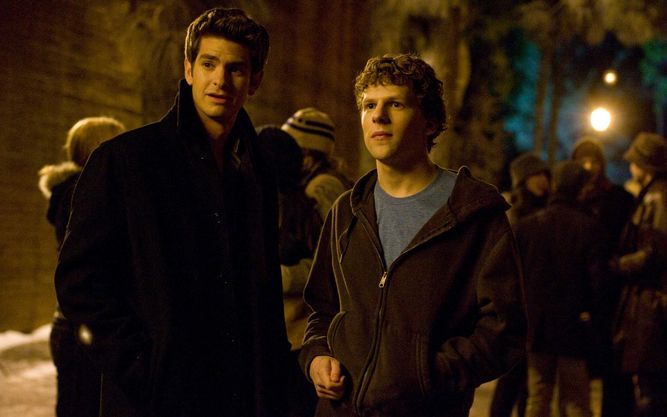
It’s fascinating how Sorkin’s script breaks so many rules so successfully. He throws out one of the cardinal laws of screenwriting, which is to give every character his or her own voice. Instead, every single person in The Social Network speaks in the voice of Aaron Sorkin. Everybody is sharp-tongued, witty, fiercely intelligent and able to speak a mile a minute.
At one point, one of the strapping Winklevoss twins argues against going after Zuckerberg because “it’ll be like we’re dressed in skeleton costumes chasing the Karate Kid around the school gym.” A wonderful line, but is that really a reference you’d expect from somebody who was three when The Karate Kid came out?
But the script works, in spades. Sorkin is creating a very stylized, very artificial environment in which to tell this very real story and he pulls it off in dazzling fashion. It’s a thrill to spend time in this world. I predict that he’ll win the Best Screenplay Oscar months from now, and he will be absolutely deserving.
It’s interesting that Sorkin has gotten much of the press surrounding The Social Network. In a director’s medium, it’s nice to see a screenwriter get the attention for a change. But David Fincher is certainly no slouch. Despite his misstep with The Curious Case of Benjamin Button, Fincher is one of the finest directors working today and The Social Network is one of his best. This film joins three others I consider Fincher masterworks: Se7en, Fight Club and Zodiac. The Social Network matches the violence in those films with verbal jabs that are no less jarring for not leaving a mark.
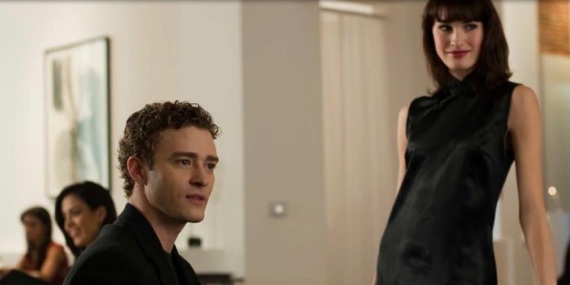
Fincher largely stays out of the way of the script. Working in digital, he brings the same crisp, modern look he favored in Zodiac and he has assembled a fabulous cast that never falters.
Jesse Eisenberg does career-best work as Zuckerberg. Eisenberg has always been appealing onscreen, tapping into the same awkward funnyman vibe as Michael Cera, but here he captures the fierce intelligence and arrogance but also the simmering insecurities in a character that is fascinating and wholly unlikable.
Justin Timberlake continues his streak of doing a little bit of everything and all of it well with his portrayal of Sean Parker, the egocentric creator of Napster. If Zuckerberg is the film’s anti-hero, Parker is its villain, the snake in the garden offering him the temptation of measureless wealth and importance at the cost of his soul.
Armie Hammer, with the aid of a body double and some seamless CGI technology, plays both Tyler and Cameron Winklevoss with equal parts smarm and charm. You can just smell the air of Harvard privilege coming off of these guys. But the film makes a compelling case that they were indeed screwed over by Zuckerberg. My one nitpick with the script is that the Winklevoss storyline gets lost toward the end before being wrapped up in a title card.

A host of supporting actors fill their roles admirably, with Rooney Mara (as the girl who dumps Zuckerberg and inspires the drunken night of programming that eventually led to Facebook) and Douglas Urbanski (as Harvard president Larry Summers) really delivering the goods.
Finally, a star is born in Andrew Garfield, the British actor who will soon take on the role of Spider-Man. His Eduardo Saverin is the film’s sole sympathetic character… he’s the movie’s conscience and the audience’s stand-in. His journey from supportive friend to blossoming entrepreneur to corporate road kill is heartbreaking, but he never loses his dignity and emerges (in my eyes) as the film’s real hero.
The Social Network is a movie that gets you jazzed up about movies, about the acrobatics great artists are capable of when everything comes together onscreen. It’s had me thinking for days… not about social networks, but about the creative process, truth vs. fiction, good screenwriting, the evocative score by Trent Reznor and Atticus Ross, that sort of thing.
Sometimes a film is great not because of what it’s about but how it’s about it. The Social Network is a triumph of the how.
 Meet Me In Montauk
I agree that The Social Network is a great film, though I can’t say I agree with the underlying premises of your review–that the film is fiction, that the film could be about
“anything” or that the irony about Zuckerberg’s anti-social behavior is not at the heart of this story. I disagree, particularly as to the latter point.
As the final scene makes clear, along with at least a half dozen other powerful moments throughout the film beginning with the opening scene with the ex-girlfriend, this film is very much about the irony of a socially inept computer geek with major relationship issues creating THE social network of our generation. That was clearly a central theme, very much intended by Sorkin, and I’m not sure how you could have either missed that or, more likely, dismissed that.
I am also not sure why you deem this to be a fictionalized account. Sorkin has said that the film is substantially based on the deposition transcripts he poured through when preparing the screenplay. The fact that Zuckerberg had a girlfriend at some point after his sophomore year doesn’t make the spectacular breakup with the first girlfriend a fiction, nor does it lessen the apparent dysfunctionality of his other relationships including, most particularly, with his best friend and business partner. Zuckerberg’s denial of certain aspects of the film doesn’t render them fiction, it makes them the very real non-fiction that is the stuff of heavily contested lawsuits.
This is, after all, a film about perspectives regarding an event. To be sure those perspectives may have been distorted or even outright false, but, to the extent they were the real perspectives of the real players, they cannot be described as fiction. Indeed, while Zuckerberg may deny elements of the story, the twins have gone on record as saying the account is largely accurate.
Now I haven’t read as much about this film as you apparently have, but I agree that the film is not about, nor was it intended to be about, the phenomenon of Facebook itself or a greater social commentary as to the way we now interact as a result of Facebook. On the other hand, I do think that this is, nevertheless, very much a commentary about our generation and, more particularly, the technology revolution that has supplanted the industrial revolution–the entrepreneurial spirit and energy created by the Internet, the ethical and legal issues that surround this evolving medium, the rapidity from which a nobody can become a multi-billionaire and the greed and mistakes that flow from that rapid ascent. Those are all issues very unique to our cyber-aged generation, and so I disagree that this film could have really been about just anything.
Anyway, while I may disagree with some of the points in your review, I do resoundingly agree as to the greatness of the acting, directing and writing of this movie. I look forward to it getting its proper due come Oscar time!
I’m not suggesting the plot points are fiction… as I pointed out, they are based on the legal record. But the underlying emotional and psychological motives for the action are invented (by the author’s own admission).
And I’m not saying that as a criticism. It certainly makes for a much richer movie. I just find it an interesting and thorny topic considering how recently all of this happened.
To your first point, had Zuckerberg invented Napster or Google rather than Facebook, I don’t think the film would be any different or worse. The nature of his creation isn’t really explored in the movie. Sure, we all know what Facebook is so we bring that knowledge with us, but the filmmakers (to their credit) don’t dwell on it.
The final scene brings home the theme of “gaining the world at the cost of your soul” quite beautifully. My point is that this movie is telling that story, not making some larger point about social networking and the digital age.
Well, of course, no outsider can truly know the emotional or psychological motives of the players here except for the actual people, and since Zuckerberg refused to to cooperate in the film, Sorkin had to extrapolate from the sources he did have. That doesn’t make the work fiction, it just allows Sorkin to theorize as to emotions and motives based on what is known.
And I agree that this film may have had similar themes if it were about Napster or Google (or Microsoft or Apple). But that actually supports my point–the film couldn’t really be just about inventing “anything”–it is unique to our post technological revolution world. Having said that, and going to my other point, the fact that this was about a social network does tie into a central theme of the movie, that being the irony that an anti-social misfit created something that has changed the way the world socializes. So, for that reason, the film could not have been just about “anything” or even any generic computer related invention.
And the final scene, to me, doesn’t just bring home the theme you suggest–it highlights the irony of how a young man who was responsible for connecting 500 million people and, in so doing, turned the word “friend” into a verb had become, through his piss-poor personality and Machiavellian ways, an isolated soul hoping that the lawyer with whom he had spent a few hours in a conference room would “friend” him. And while you can argue that this is just Sorkin’s spin on Zuckerberg’s emotions and psyche, all that I have read about the real guy suggests that, other than the fact that he has a girlfriend, he is largely isolated and socially inept. So, I’m not sure the emotion and irony captured in that last scene are much of a stretch.
That wasn’t the lawyer he was trying to friend, it was the girl who dumped him in the opening scene.
And I disagree that the central theme is the anti-social vs. social thing… I think that’s an added layer (and a neat one) but not the central theme.
But I do think it’s funny that we can argue even about a movie we both agree is great!
Oh, ha–well I guess that’s what my poor eyesight gets me!
Still, the message isn’t all that different–Zuckerberg’s need to have that connectivity with someone, obsessively re-clicking the refresh button to see if she accepted his friend request on the very platform of connectivity he created speaks to his social dysfunction. And that social isolation is enhanced by the fact that the man who created Facebook only had 2 unread messages as he was repeatedly refreshing the page. That this is the last scene in the movie strongly suggests that this was a theme that Sorkin wished to leave the audience thinking about.
You couldn’t see who the girl was but you could see that he had two unread messages?! 🙂
Well, I guess I just assumed he was trying to befriend the lawyer in light of the their last exchange, so my eyes just went along with my assumption there. I did wonder, by the way, why he would think that she would see his friend request as soon she left the room, presumably on her phone, and jump on friending him right away.:)
As for the message box, my eyes go to that like a lightning rod:)
I agree with much of what you say, and find this exchange between you and Dana to be amusing as usual. Still, I take some issue with your suggestion that Sorkin wrote the fictional Zuckerberg as obsessed with the social clubs or consumed by jealousy. I didn’t get either of those impressions. What was the object of his jealousy? The Winklevii?
The fact that he raised an eyebrow when Eduardo got an inivte to a club doesn’t mean that he was either jealous of Eduardo or obsessed with the clubs. As Dana points out, it’s a matter of perception, and Sorkin floats it out there to allow us to interpret it as we will (and shows us the way the attorneys chose to interpret it, for their obvious reasons)
Regardless, I loved the movie and completely agree that it was stolen by Andrew Garfield.
The opening scene establishes that Zuckerberg is more than a little interested in getting into the clubs. And while Eduardo’s comment to him after being screwed (something like “Is this about me getting into the finals club?”) is clearly from his perspective, I think it feeds a general theme that the film’s Zuckerberg was an outsider jealous of the lives other Harvard men lived (the juxtaposition of his mad hacking and the Caligula-like girls-bussed-in party also drove home that point).
I loved the film, hate Facebook. And I would argue that it is fully understandable that a social misfit would have created an ersatz “social” medium such as the one Facebook has become. Facebook is made for people who are uncomfortable with human contact and prefer to be unencumbered by it. It’s easier to click “like it” than to pick up the phone and chat about why you like it. It’s easier to type than to talk. None of this has anything to do with the film, but I need to vent about Facebook and do so whenever I’m given the opportunity. Thank you.
Ummm….. I beg your pardon. I am quite comfortable with human contact, yet I enjoy “liking” the odds and ends shared by former students, relatives, and colleagues who I might rarely (if ever) actually pick up the phone to call. Why is it either/or?