 Few directors in Hollywood can boast an artistic and commercial winning streak to rival that of Christopher Nolan. He has successfully split his time between psychologically meaty brain-teasers (Memento and The Prestige) and big-budget summer spectacles (Batman Begins and The Dark Knight).
With his latest film, Inception, he has managed to deliver both at once.
Inception is as twisty and debate-worthy as any film Nolan has made, but it works just splendidly as straight-up entertainment. On its face, this is a heist film about a team of well-skilled thieves who join their leader on “one last job.” The twist is that on this job they aren’t stealing something but leaving something behind, and they aren’t breaking into a place but into their target’s subconscious.
Leonardo DiCaprio plays Cobb, a man who has perfected the art of entering people’s dreams in search of secrets. His own dreams are haunted by visions of his late wife (a spooky Marion Cotillard), who went too far down the same rabbit hole Cobb constantly circles. Implicated in her death, he agrees to pull off a crazily ambitious job for a wealthy businessman (Ken Watanabe) who promises to clear Cobb’s name in return.
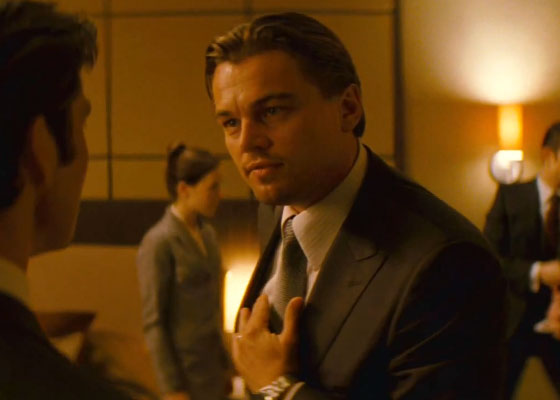
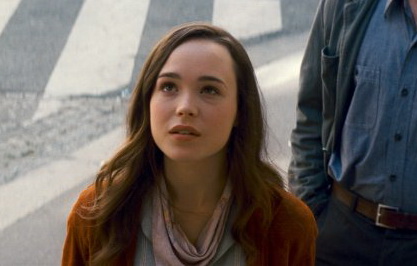
Rather than revealing a secret, Cobb’s task is to plant an idea — a process called inception — into the mind of his client’s rival. Because the mind is quick to sniff out an alien intruder, the mission will involve going several levels deep into his target’s subconscious. Cobb quickly assembles a team, including new recruit Ellen Page, right-hand man Joseph Gordon-Levitt and a scene-stealing Tom Hardy.
Nolan does a nice job setting up the rules of this universe without weighing down the film with exposition. Page’s character, Ariadne, serves as a stand-in for the audience and Cobb spends a lot of time explaining to her how things work. These early scenes are some of the film’s most visually arresting, the special effects serving as the spoonful of sugar that helps the medicine go down.
Inception works better as a psychological thriller than as an action film. Despite helming the 3rd highest grossing film of all time — a superhero movie, at that — Nolan is not a great action director. A late snowy shootout (reminiscent of a scene in a James Bond film) goes on way too long and never makes it clear who’s firing at whom.
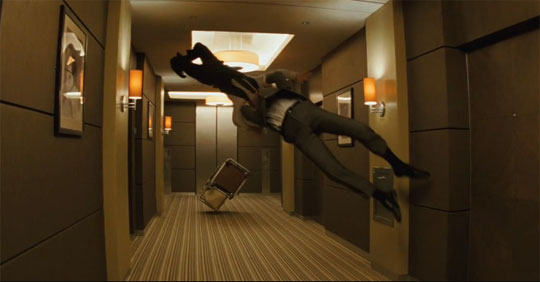
That said, Nolan delivers a beauty of a fight scene between two characters facing off in a hotel hallway in zero gravity. In a film that borrows heavily from movies across several genres, that sequence (overwhelmingly voted the film’s best in an Entertainment Weekly poll) feels like something brand-new.
The principal question raised by any movie that spends this much time in the dream world is, “Is it real?” And on the most basic level, the answer is “Of course not! It’s a movie!” Nolan plays with the connection between the dream-making his characters do and the dream-making of a filmmaker.
Cobb’s team consists of an art director (the dream’s “architect”), a make-up artist (Hardy’s character, Eames, a “forger” who can change his appearance within a dream), an assistant director (Gordon-Levitt’s “Point Man”) and even an executive producer (Watanabe’s Saito, who puts up the cash and insists on a supporting role).
David Lynch mined similar territory in his Mulholland Drive, in which Hollywood, the city of dreams, becomes quite literally a city of nightmares. That is the richer and more meaningful film. But it didn’t have the added burden of being a summer blockbuster. I sure don’t recall Naomi Watts wrestling a thug in zero gravity.
In a season when mindless entertainment rules the multiplex, Nolan and company have delivered a spectacular thrill ride that aims at the brain and the gut. Inception is the rarest of finds — an art-house popcorn movie.
Warning: Spoilers below! Read only if you’ve seen the film!
Now, because everybody who sees Inception has to offer up an opinion on the ending, I’ll post mine here. I believe Cobb’s final scene takes place in reality, not a dream, and I believe that for a couple of reasons.
First, it is established throughout the film that dreamers don’t fall asleep within their own dreams. As the team goes deeper and deeper into levels of subconscious, the dreamer of each level stays behind to wake up the rest of the team. If that’s the rule, the top level must be reality because Cobb is seen falling into his own dreams on several occasions. Of course, it could be that the top level is somebody else’s dream, but whose?
Second, I just find it far more satisfying if the primary events of the film take place in reality because it makes the stakes real for all of the characters. If everything, and everyone, we see is simply a projection of Cobb’s unconscious, we’re left with nothing real to hold on to and care about. So without any concrete evidence one way or the other, I’ll choose to believe the more satisfying version.
And what of the spinning top? I agree with a comment I read somewhere online… it is Christopher Nolan’s inception on the audience. He plants this idea that what we’ve witnessed may or may not be real and cuts away before revealing the answer. In doing so, he sends every audience member back into the light with that question eating away at our brains: Is it real?
 Meet Me In Montauk
Great review. I love your developed analogy of a film’s creation to the dream’s creation – very clever.
I won’t comment on my view of the ending just yet, for fear of spoiling. I will say that I agree with your second point, but I do think I have a convincing answer for the question you raise at the end of point #1.
Another great review, even if we haven’t seen the movie yet. I think this would be a good one to see and then I’ll return with my thoughts!
I’ve been anxiously awaiting your review of this movie and you didn’t disappoint. I think you’ve done a great job describing the movie without giving too much away. I happened to love this movie. It is the first movie I can remember in a long time where I left the theater exhilirated about what I’d just watched. The last one may actually have been The Dark Knight, now that I think about it. Hmmm…. interesting…
I have heard the criticism from some that it’s a “poor man’s version of ‘The Matrix’.” I say that’s like comparing apples to kiwis – for me, they were in no way alike apart from the anti-gravity fight scene and even that didn’t make me think of “The Matrix” while I was watching it. And I’ve heard people complain about the ending. These are people without imagination as far as I’m concerned. Exactly what I loved about the movie was that it made you think. I agree with you completely about the welcome place for this film amongst the “mindless entertainment” that is so pervasive in summer movies (like “Salt,” for instance). I liked “Salt” just fine – it was action packed and entertaining enough, but I figured it out in the first 5 minutes and then just got to watch the pictures. “Inception,” on the other hand, had me fully engrossed for the duration of the film.
As to the ending, I have gone back and forth on this, but I think you make strong arguments. I probably need to see it again before I can make a case I can really stand behind.
All I can say for sure is, I can’t wait for the next Nolan film – especially in the Batman franchise!! 🙂
The more I have thought about the ending, the more I am convinced that everything we see in the entire movie, including the ending is Leo’s dream (i,e, he is the mark or target), and the wife is/was the architect/dream intruder.
My support? Well, the spinning top is the most obvious evidence. That is her totem, after all, not his. As such, how would HE know about it if, given the rules created, only the intruder can know his/her totem. He shouldn’t know about it, and there is never a good explanation as to why he does know (what, did she write a note in a will telling him?) Also, the fact that the top is spinning in the last scene provides that wink and nod that all of this was and is still a dream. The ending also remains rather dreamlike–with HER father leading Leo to see the children, who are playing in this rather surrealistic way.
More evidence? The premise of the movie is that the dream invaders must go so deep into someone’s dreams, on multiple levels, because when they plant the “idea,” it is imperative that the target think the idea is his. Here, the “idea” that must be implanted in Leo is that he must move on from his tortured memories of and relationship with his wife and their “life” together, By showing her die in one iteration of the dream, Leo can become convinced that she is gone, and, at the same time, by finally recognizing that he has lived a full life with his wife (though in a 3rd level dream of their making) and has no need to remain in that world or any other dream state where the wife is two dimensional, he can move on by going to the next stage of his “life” (which is really just a higher level of the dream where he will be with his children, but not her.
Of course, with this theory, one must assume that the wife is not really dead, but this begs the question as to what really “happened” between Leo and her. There are several possibilities, including the notion that she wished to remain in that 3rd level dream, but he didn’t or that he wished to remain, but she didn’t (which makes a bit more sense as it would explain why she is actually in the real world, but still manipulating Leo to the outcome she desires through the multiple levels of his dream state)
Additional things that make me believe this was Leo’s dream are the things the wife says quite bluntly near the end–to the effect of “do you really believe that this could all be real, that you are constantly on the run and that all these people are out to get you, etc….” While so many things in the movie seem plausible on one level, they are really patently absurd when put to any scrutiny–the Chinese man with the mysterious business concerns, –the idea that Leo was given some sort of choice by some mysterious man at the exact moment he is staring at his children (who are playing in the exact same way as they are at the end of the movie) and he made the wrong choice, the notion that he must go through these absurd Herculean efforts so that the mysterious Chinese man can “make a call” and restore Leo’s life. The idea that the wife’s father just happens to have a young master architect handy to loan to Leo to pull off this master inception (and, by the way, I’m fairly sure Ellen Page’s character is basically the wife in disguise (the forger), which makes sense both because of the affiliation with her father and the fact that Page’s character is a genius architect akin to what the wife was/is). Anyway, all of the “plot” of the movie seems “real” in the dream state, but is, of course, askew, when viewed through any prism of reality. And, again, that is, in and of itself a “rule’ of the movie, as stated….that the dream world will be “off” from reality, but can’t be so off that it let’s the dreamer know he is dreaming.
I also think that the way the characters interacted (or really didn’t interact) after Leo “woke up” shows that Leo is continuing to dream through the end. If all of the characters on the plane had actually woken up from the target’s (rich prince’s) dream and had survived and/or succeeded, wouldn’t there be some acknowledgment of that? Some high fiving, a wink or a nod, something? Instead, the characters all walk off like strangers.
Also, another “rule” of the movie (and a truism in dreams) is that the dreamer begins the “scene” of the dream in the middle–not really thinking about or knowing during the dream how he got there. That fits perfectly because, if we were to believe that Leo woke up on the plane, what the hell was he really doing there in the first place? Again, even with the first scene of the movie, book ended near the end, we come into the scene midway–we land in the middle of a crazy plot with really no good explanation as to how Leo got there (oh yeah, that’s right, mysterious man with envelope in home makes him a mysterious offer he can’t refuse while Leo stares at surreal looking kids playing).
Anyway, I have more to support my theory that this was Leo’s dream, with the wife as the intruder into and architect of that dream, but I have prattled on quite enough. Time for me to go to sleep and have MY usual dream about being shoeless and pantless in the court room on the first day of trial.
Night all!.
Excellent support for the “not real” theory, and one I’ve kicked around myself quite a bit.
A few responses. First, the top is spinning at the end, but we don’t see if it will continue to spin or not. It does wobble a bit and some viewers report that you can hear it topple after the screen goes black (or perhaps they dreamed that). But I think the point of the final shot is that we don’t get to know for sure, so we can’t legitimately use the top as evidence either way.
I, too, was intrigued by Mal’s comment that his life of intrigue was itself very dreamlike. Stalked by mysterious forces, etc. It reminded me a whole lot of the end of Total Recall, where Schwarzenegger’s character is told that the events of the film were taking place in his mind, according to the guidelines he himself constructed. As in Inception, that film ends with a wink, never telling us if what we’ve seen is reality or fantasy.
I look at the whole “begin a dream in the middle” concept as another nod at cinema. After all, it’s pretty much impossible to begin a film anywhere but the middle of something. Almost every action film ever made starts in the middle of chaos. I believe Nolan did that on purpose, quite playfully.
As to your last comment, if my theory is correct, it is interesting to note that the wife would have never been seen in reality. She would therefore be as off screen as Nolan. In other words, in some sense, whether the architect is the wife or Nolan, it really doesn’t matter–either way, there is a blending of cinema and dreams, reality and fantasy, all being told and manipulated by people beyond camera shot.
Good point. Following that analogy, the dreamer is the audience and the architect is the writer/director. Inception is the dream that Nolan constructed for us.
Dana’s analysis is really fantastic (and I find myself largely in agreement). If I wasn’t in the process of writing multiple drafts of my comprehensive exam paper proposal, I might have the brain power to muse about the dream or reality issue as well. I’ve kicked it around a lot, but I think I keep coming up with the same answer – I want to see it again! 🙂