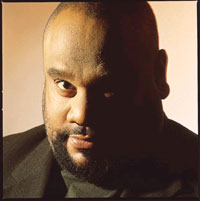
 Stew — the creative mind behind The Negro Problem, three solo albums and the Broadway musical Passing Strange (soon to be released in film version by Spike Lee) — is a fine example of somebody who practices songwriting as both an art and a craft.
I compare him to Ben Folds in that sense. These are people for whom lyrics and melodies are as natural a language as their mother tongue. They are capable of crafting a tune that plumbs the deepest emotions but also spinning off a catchy number on the fly about a roadie they saw trip backstage.
I’m not sure if he still does this but at one point Stew had an offer on his Web site to write a song for anybody who requested one (for a fee). All you had to do was send him a list of details about the topic you wanted him to cover. Say it was your significant other… you give him her name, a brief description, a few of her quirks, a sense of what it is you love most about her… and he sends you a song. I considered doing this once as a birthday gift but the price was a little high ($500).
He has a track called ‘Statue Song’ on his most recent solo album, Something Deeper Than These Changes, that he wrote in response to a classroom assignment (not sure whose class) that asked for a poem from the perspective of an inanimate object. His song, from the perspective of (you guessed it) a statue is among the more poignant tracks on that album.
Today’s song, released on The Negro Problem’s great album Joys & Concerns, seems like it might have sprung from the same sort of challenge. It’s written from the perspective of a Ken doll — in this case a gay Ken doll. It could be a throwaway but he manages to get in a few lines about race and gay rights that make it something a little bit more.
But the people at Mattel
The home that I call hell
Are somewhat bothered by my queer proclivities
It’s safe to say that they are really pissed at me
They always stick me with Barbie
But I want them to know I prefer GI Joe
But any able bodied man-doll will surely do
Just someone to love, since I am not set up to screw
Black Barbie
You know she used to talk to me
But now she’d rather be in plastic therapy
Sitting on a plastic couch speaking freely
The only problem is she has no history
Some day soon I’ll be in your child’s room
And I’ll be forced to kiss Barbie’s plastic tits
And I will hate myself, but what’s more I’ll hate you
For not allowing me to love as I wish to
See, I’m your corporate toy
Cursed to bring you joy
And through divorce or death
I’ll just hold my breath and play along
Your daughter’s not to blame at all
For bringing these burdens to bear upon a doll
 Meet Me In Montauk
How do you interpret the final two lines of the song? Is he being ironic or sincere? Does he blame the Mattel marketing machine for forcing a particular world view or the individuals who buy into it? After all, I bet there were many young gay kids who had yet to officially come out to themselves let alone the world who “experimented” with Barbie liking Stacy (or whatever her name is), and Ken hooking up with G.I. Joe.
I think they’re sincere. It’s Mattel that expects him to conform to “normal” societal standards, and markets him that way.
What a great song. I really liked the one Stew album you gave me as a birthday present. Clearly, he continued to do interesting work after that.
Oh, and by the way, $500 for a song isn’t that bad—I say we go in together and have him write a song about our kids:)
Actually, this one (and most of the Negro Problem stuff) came before the solo albums. I’ve been waiting for something new from him for awhile.
Yeah, I agree that $500 is a pretty good deal, though it was a little steep for me at the time.