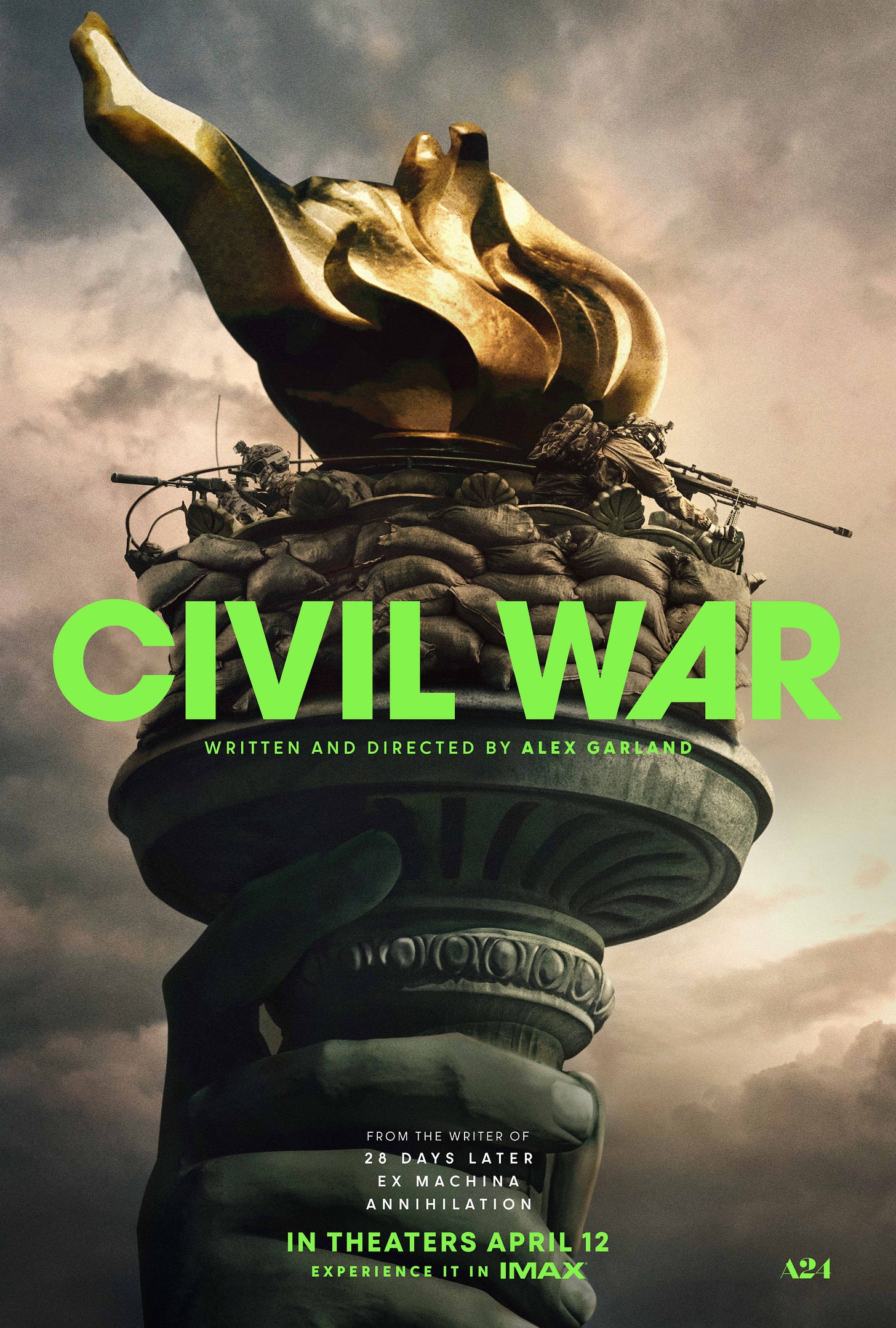
 Continuing my countdown of last year’s best films…
Best Films of 2024
#9. Civil War
I can’t recall the last time a trailer generated as much controversy as the one for Alex Garland’s Civil War.
Some people thought it was irresponsible for a film to depict a modern-day civil war, particularly at a time when our politics have the country hopelessly divided and norms have eroded to the point that citizens believe storming the Capitol to overturn an election is an example of peaceful protest.
Others laughed at the film’s teased Texas/California alliance, assuming Garland (a Brit) was so ignorant of American politics that he didn’t know how to properly draw the battle lines.
The movie itself proved less divisive. It was well-reviewed and became studio A24’s highest-grossing release. It didn’t incite violence or paint any targets. On its surface, it’s an expertly crafted road movie about the ethics of war journalism. And it’s that surface level that proved most effective for me.
Kirsten Dunst plays veteran photographer Lee Smith, the anchor of a team of journalists hoping to reach the president before the White House is captured by the opposing Western Forces. Cailee Spaeny is Jessie, a young woman who wishes to follow in Lee’s footsteps. Wagner Moura and Stephen McKinley Henderson are reporters — one in his prime, the other near the end of his career.
The team heads from New York City to Washington, D.C., encountering a wide range of Americans responding to the civil war in their own ways: a group provides food and shelter at a stadium; a pair of soldiers is pinned down by a sniper; a small town carries on as if nothing unusual is happening outside its borders; a sadistic soldier prepares a mass grave.
Each episode raises questions about the responsibility of those chronicling the atrocities. Is it wrong to take a picture rather than help the person you’re photographing? What does it mean that you find a gun battle exhilarating? Does journalism even matter in a country lost to war?
Having worked in a newsroom, I recognized the gallows humor journalists lean on as a defense mechanism (granted, my years in suburban Palm Beach County weren’t exactly war-torn, but the DNA is the same). These characters felt familiar and real.
Dunst, in particular, is wonderful as Lee, her years of experience visible in her tired eyes. “Every time I survived a war zone, I thought I was sending a warning home – ‘Don’t do this,'” she says, “But here we are.”
Garland’s film seems to be sending the same message, but not preaching it. Civil War is sometimes exciting, sometimes harrowing, sometimes both at once. It leaves you on an uneasy note, unsure who’s won or lost, or if winning is even possible in a country split apart.
Oh, how the breakers roar
Keep pulling me farther from shore
Thoughts turn to a love so kind
Just to keep me from losing my mind
So enticing, deep dark seas
It’s so easy to drown in the dream
[Verse 2]
Oh, and everything is not what it seems
This life is but a dream
Shatter illusions that hold your spirit down
Open up your heart and you’ll find love all around
Breathing and moving are healing and soothing
Away all the pain in life holding you down
[Verse 3]
Bone breaks and heals
Oh, but heartaches can kill
From the inside, so it seems
Oh, I’m telling you it’s all a dream
[Outro]
It’s all a dream
It’s all a dream
It’s all a dream
It’s all a
It’s all a dream
 Meet Me In Montauk
I definitely found the film compelling, but it lost points with me for not having at least some exposition as to what caused and continued to fuel the civil war. I know that was an intentional decision by the filmmaker, but I feel it detracted rather than added to whatever message or lesson was trying to be conveyed – making the film ultimately feel like groundless violence porn.
I remember not wanting to see this movie as I try to avoid violence in movies. However I am glad I was convinced to see it and thought it was very good and worth while. I agree and appreciate your description of the journalists and the news room environment.