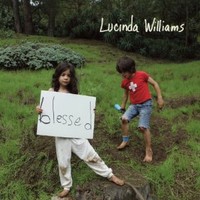
 Befriending Lucinda Williams might be hazardous to your health. Her albums are littered with songs about loved ones lost to suicide and disease. She mourns beautifully.
Williams’ newest release, Blessed, features two such tracks. The first is the wistful, poetic ‘Copenhagen,’ describing the moment she learned, while traveling abroad, about her manager’s sudden death. The second is ‘Seeing Black,’ an angry response to the suicide of her friend Vic Chesnutt.
Elsewhere, in ‘Soldier’s Song,’ she contrasts the experiences of an enlisted man in a war zone with that of his wife and child back home. It doesn’t end well for the soldier.
Depressing stuff, to be certain, and yet there are more moments of grace on Blessed than any other Lucinda Williams album. ‘Born to Be Loved’ is a lovely, reassuring lullaby. The title track offers up a laundry list of life’s unsung heroes.
‘Sweet Love,’ written for her new husband, is the most romantic song she’s recorded to date: “Who would have ever guessed I would be here where I am like this, with you, my dear, my sweet, sweet love, to drink my words in and make each moment become a celebration… my breath is yours to share, everything in me and of me is yours forever.”
Thirty-three years into her recording career, Williams seems to have synthesized her passion and pain into a consistent and comfortable worldview that can maybe best be described as “Shit happens, but good stuff happens too, and either is better than nothing happening at all.” Life is a blessing… an ugly, painful, beautiful, wonderful blessing.
Every Lucinda Williams album is a marvel of one sort or another, but Blessed is more marvelous than most. Without diminishing the stellar work she’s produced over the past decade, I think it’s safe to call it the best album she’s put out since Car Wheels On a Gravel Road.
That’s due in large part to the blues-rock ensemble she has behind her. Some of these songs ease along on a moody groove so rich you never want it to end. Others hit hard and fast, like ‘Seeing Black,’ its blistering guitar courtesy of Elvis Costello. Album closer ‘Kiss Like Your Kiss’ is a delicate waltz on acoustic guitar over quivering strings.
Williams is in fine voice on this record, meaning she drunkenly slurs with more conviction than ever. Williams has one of the most provocative and evocative voices in the business, a voice rich with experience. “You say you feel like a failure and wish you could take it all back,” she snarls in the splendid kiss-off ‘Buttercup.’ “Well, honey I gotta tell you, it’s a little too late for that.”
But her softer side is tender as a bruise. In ‘I Don’t Know How You’re Livin’,’ perhaps a companion song to her early song ‘Little Angel Little Brother,’ she reaches out to somebody who’s lost his way:
I don’t know where you are
And you may not be willing to open up the door
If you should ever wonder
You shouldn’t have to ask
Cos I hope you know, brother
I’ve always got your back
If I have one nitpick about Blessed, it’s that too many songs feature a repetitive blues structure. Williams is a master of that form, but it limits her more adventurous songwriting. I’m more interested in an off-kilter mood piece like ‘Copenhagen’ than the simple AAB rhyming pattern of ‘Born to Be Loved.’
But every track here is solid, and as a whole they form one of the most cohesive collections of her career. At 59, Williams seems to be just hitting her stride. With any luck, we’ll be blessed by her music for many more years to come.
 Meet Me In Montauk