 It’s hard to think of a movie in recent years with a bigger marketing problem than Danny Boyle’s 127 Hours. If you know anything at all about this film, you know it depicts the true story of an adventurer named Aron Ralston who finds himself pinned by a rock in a Utah canyon and has to cut off his own arm to escape.
So here’s a film that spends most of its running time with a single character at the bottom of a dimly lit canyon and builds to a horrific scene of self-amputation.
Good times!
But somehow 127 Hours is neither boring nor grueling — on the contrary, it’s one of the most exhilarating and life-affirming films I’ve seen in years.
Much of that credit belongs to director Danny Boyle, who brings the same whiz-bang cinematic artistry to the film’s early scenes that he delivered in the Oscar-winning Slumdog Millionaire. Boyle kicks things off at a frantic pace, inter-cutting Ralston’s hurried preparation for a day of hiking with shots of a sea of people going about their busy lives.
The idea is to display a contrast between the busyness and impersonal nature of everyday life and the incredible isolation and solitude to come. At times the frenzied split-screen action of the opening scenes feels like a bit too much, but it’s appreciated minutes later when everything comes to a halt.
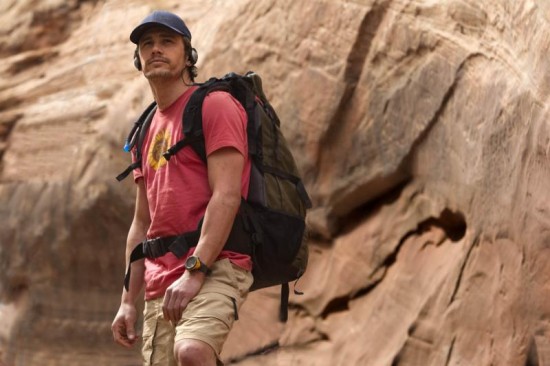
From that point on, 127 Hours turns into an almost documentary-style recreation of the ordeal Ralston faced once pinned by the boulder. And that’s also where star James Franco dials up one of the finest performances by an actor this year (one that will no doubt see him nominated for an Oscar at the ceremony he’s hosting with Anne Hathaway).
Franco brings an immediacy and intimacy to this role that strips away any pretense of “acting” — I believed from the very first second that he was truly going through this horror. Credit for Franco’s performance goes to Boyle as well, for his decision to shoot uninterrupted takes for 20-30 minutes, letting Franco live in the moment in real time.
Ralston had still and video cameras with him when he was trapped and used both to document his situation. The film makes effective use of that device, giving Franco a chance to communicate with the loved ones he’s left behind. In an imagined interview with himself, he reveals that he hadn’t told anybody where he was going before setting off on his trek. “Oops,” he deadpans.
Everybody I’ve talked to about this movie has asked how horrible the amputation scene is to watch. And my answer has been that while yes, it is physically quite disturbing, it is actually the most exhilarating moment in the film.
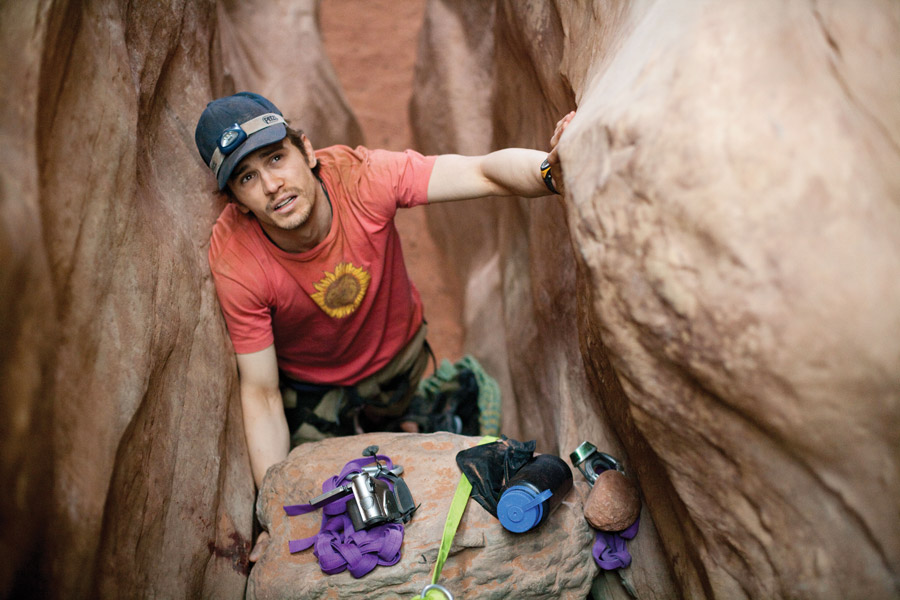
Ralston has been trapped for days, essentially accepting that his life is over, when he finally decides to try to free himself. As he methodically works his way through muscle, bone and nerves, he experiences an awakening. He can actually defeat this impossible situation and emerge alive. Watching him accomplish that unthinkable task gave me an adrenaline rush. It’s a triumphant moment — the reason everybody should see this film, not the reason to avoid it.
At one point, speculating on how incredibly improbable his circumstance is, Ralston decides that every moment in his life, as well as every moment in the existence of that large rock, has led to this violent collision. It’s a profound thought, and one that gives the film meaning beyond the simple re-telling of a compelling tale.
I left the theater wondering what boulders are out there in my own life. What unexpected calamities — and challenges — await me, ready to put me to the test?
In the film, as Ralston finally leaves the bloody prison he’d been trapped in for five days, he snaps a picture and says a quiet “Thank you.” The ordeal had strengthened him emotionally and mentally even as it nearly killed him physically.
It’s a cliché — what doesn’t kill you makes you stronger. But seeing this true story play out made me believe that whole-heartedly. How precious life is, how worth fighting for. And how strong is the human spirit even in the darkest days.
It took Aron Ralston 127 hours to learn than lesson. Danny Boyle and James Franco deliver it beautifully in just over 90 minutes.
 Meet Me In Montauk
Great review of a truly great film. In many ways, this film reminds me of Alive, another film based on a true story about those things we can’t imagine bringing ourselves to do in order to stay alive. Just as that film has everyone buzzing about the notion of cannibalism, this film has everyone buzzing about the notion of self-amputation. Both films manage to make those scenes depicting the buzz-worthy scenes less and more than the audience imagines they will be.
I saw an interview with Ralston where he discusses the epiphany that enabled him to free himself – the rock was not his enemy; the knife was. When he stopped viewing the rock that was pinning him as the enemy, he realized he could use it to break the bones in his arm that were too hard for the knife to cut. The fact that he considered cutting his arm off from the very first day but only came up with the solution as to HOW to do so several days into his ordeal was a detail I didn’t know, and one that made a tremendous impact on me. That, too, is similar to Alive, where the survivors rationed out chocolates and wine for days before allowing themselves to consider that which all of them knew was the most logical way for them to survive.
I wholeheartedly agree with you, Clay, that films such as these two are utterly inspiring. While I can’t imagine ever winding up in Ralston’s situation (solo hiking in Utah is simply not my calling), I would hope that my survival instinct would kick in to allow me to make the difficult decisions that would enable me to live. Regardless of whether I actually would be able to do so, it heartens me to know that there are those among us who are.
Excellent review and comment Clay and Amy. I don’t have the stomach o watch this movie, but I do appreciate the courage and the “story” of this incredible man.