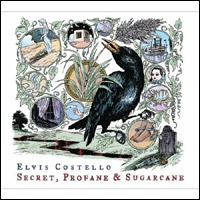
 Elvis Costello has been releasing albums both major and minor about once a year for three decades now, which is an achievement in itself. That only one or two of them can be considered mediocre, and not one truly bad, is an astonishing accomplishment. And his latest album, Secret, Profane and Sugarcane, puts him in no danger of breaking that streak.
It is, though, one of his “minor” albums, a genre exercise that recycles a few older tunes and doesn’t aim too high. It’s a low-key collection of old-timey bluegrass numbers about carnival men and slave traders, loose women and broken-hearted men. The songs are not as innovative or strong on melody as Costello’s best output, but they work well as a group.
The songs are steeped in the American country tradition — two of them were originally penned for Johnny Cash and my favorite track, “I Felt the Chill Before the Winter Came,’ was co-written with Loretta Lynn. But I’d hesitate to call this a country album because it feels older, more classical than that. But if you had to choose a genre, something almost all of Costello’s music makes difficult, I suppose country would be it.
But few country albums feature the lyrical extravagance of Elvis Costello. Now that’s not always a good thing — he has certainly over-written his share of songs — but here he has penned a set of lyrics that make for an interesting read as well as a listen.
From ‘My All Time Doll’:
On the blank back side of that poisonous moon
I tried not to think about you
I thought I was immune…
From ‘I Dreamed of My Old Lover’:
Where they seal the lovers’ lips with lead
And all the vines wind through their eyes
But no one knows this passion now
So I keep this fancy to myself
I keep my lipstick twisted tight
I long to fall asleep again
‘Cos I dreamed of my old lover last night
The liner notes of Secret, Profane and Sugarcane make a strong argument for buying physical CD’s rather than digital files. Each song gets a lyric page complete with an evocative pencil sketch illustration and a few lines by Costello explaining the tune’s origin. The write-up for ‘Red Cotton,’ for example, reads: “P.T. Barnum Reads An Abolitionist Pamphlet While Manufacturing Souvenirs Of The ‘All-American Tour’.” Top that, iTunes!
Ultimately, this album rests somewhere in the bottom half of Costello’s discography, not through any fault of its own but because it doesn’t really aspire to more than that. It looks and sounds great and treads old ground quite comfortably. Most of all, it’s another reminder that one of our finest songwriters and performers shows no signs of slowing down.
 Meet Me In Montauk
On our way back from the lovely weekend to Foxwoods, talking about the Diana Krall concert and the good time we had, the radio station we were listening to had an interview with Elvis Costello and he talked about this album. It was a great interview, and we felt like the timing was perfect.
I agree with much of what you have said, although it is hard for me to label this one of Elvis’ lower tier albums, perhaps because it is simply still too new to me. Of course, when I heard it was coming out and was being produced by T Bone Burnett and likened to King of America, my expectations were off the charts. This album is no KOA, but, really, it’s hard to imagine any album could be. It is, nevertheless, a collection of some finely crafted songs. And I agree with you that labeling this country music seems incorrect since Elvis is really digging back to the roots of bluegrass and folk. And I also agree that his lyrics, once again, make even the most “basic” of tunes provocative.