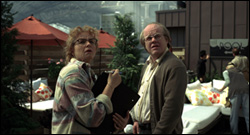
 In trying to piece together Charlie Kaufman’s wild, visionary new film Synecdoche, New York, I’ve decided to gather some random thoughts about the film here in the hopes that others will drop by and help flesh them out into actual answers.
Major spoilers follow… do not read on if you ever plan to see this film.
First, in looking at the most celebrated of Kaufman’s earlier screenplays (Eternal Sunshine of the Spotless Mind, Being John Malkovich and Adaptation) it strikes me that, like Synecdoche, each of them takes place largely inside the head of a main character.
Malkovich is an obvious one, as its plot concerns a portal into the consciousness of the titular actor, but it’s actually the least representative example. Eternal Sunshine is told almost entirely in Joel’s mind… in other words, the scenes we witness are not ‘reality’ but reality through the prism of Joel’s memory. Likewise, Adaptation is the embodiment of the script being written in the film itself… the movie we see is the vision of Charlie and Donald Kaufman, two characters in the film.
That pattern suggests to me that Synecdoche, New York also exists within Caden’s mind in one sense or another. The fantastic and confusing events in the film support this suggestion even more than anything in Kaufman’s previous movies — a house perpetually on fire, great leaps through time and space, leaf tattoos that fall from a woman’s body… there is little to suggest that we’re looking at anything close to the real world here.
The question is, to what extent do the images on screen correspond to the “real” Caden’s life? Is there a scale model New York in a giant warehouse? How many wives and daughters does he have? Is he really sick? Does the therapist exist? I don’t know if the answers to these questions are contained in the film or not. I guess that’s part of what I want to figure out.
Other thoughts:
— What is the significance of Adele’s miniature paintings, especially as contrasted to Caden’s life-size reenactments?
— What is the meaning of the house on fire?
— What is the significance of the leaps in time? In the opening scene alone, the date changes from September to October to November over the course of what seems to be an hour. Perhaps this symbolizes how fast our lives pass us by?
— How many daughters does Caden have? Is Ariel real?
— Does the bathroom faucet to the forehead shift the narrative in any meaningful way? Is it the ‘down the rabbit hole’ moment for Caden?
— What does the Ellen character (the cleaning woman Caden impersonates to gain access to Adele’s home) represent?
Please post your thoughts on these questions and add any of your own.
 Meet Me In Montauk
-God
-God
-God; yes
-3; yes
-Yes
-God
I apologize for Dana (having just inadvertantly posted under his guise).
Intriguing questions all, but most of them require a second viewing for me to begin to provide a thoughtful response. I wish I had these questions as a sort of viewer’s guide to peruse before going into the film. I’m only half joking.
Of course, I agree with your observation about this likely taking place inside the head of one of the characters, and Caden is certainly the most likely suspect, though I could also make a case on behalf of Hazel (esp. with the house burning). The title suggests that if the action doesn’t take place literally inside his head (as it does in Kaufman’s other films) that it at least takes place there symbolically. Just as the miniature paintings represents something larger than themselves, so, too, could Caden’s perception of the world around him.
Still, the whole thing gives me a headache. I don’t even remember who Ariel is for crying out loud.
Not to mention a rival blog 🙂 but you have to check out Roger Ebert’s blog on this film, followed by some far more astute comments than mine. I felt as though I was pursuing a masters degree just by reading and attempting to analyze what’s being said over there. Most of their suggestions about the house on fire (a relationship in shatters, the physical body that is decaying from the moment we occupy it, a house in which turmoil exists but everyone ignores it )- had been somewhere inside my mind, articulated clearly or not. Ebert also mentions that Kaufman is asked most frequently about that aspect of the film (maybe b/c it’s the one question audience members can actually articulate?)
Fascinating stuff.
btw, my favorite interpretation from over there is that Cade in actually a woman, and a lesbian just for good measure. The notion that Caden is actually a woman kept coming back to me, certainly by the end w/ Dianne Wiest assuming his role as the director. Thoughts?
I was reading some of those comments yesterday as well… good stuff. Not sure I see the purpose behind him being a woman (not that everything else in the movie has an obvious purpose, either). His appearance definitely became more feminine toward the end when Wiest took over.
Also, there were many suggestions by the grown-up daughter that he was gay.